Marketing budgets in India are being questioned harder than ever, and the debate almost always lands on the same comparison: earned media vs paid media. One promises credibility you cannot buy; the other promises reach you can switch on tomorrow morning. Founders are routinely told they must choose. The truth is more useful: they do different jobs, and confusing those jobs is why so many brands burn money without building trust.
This article explains what each one actually delivers, when paid media quietly fails, when earned media is genuinely not enough, and how Indian brands should sequence the two.
What Is Earned Media?
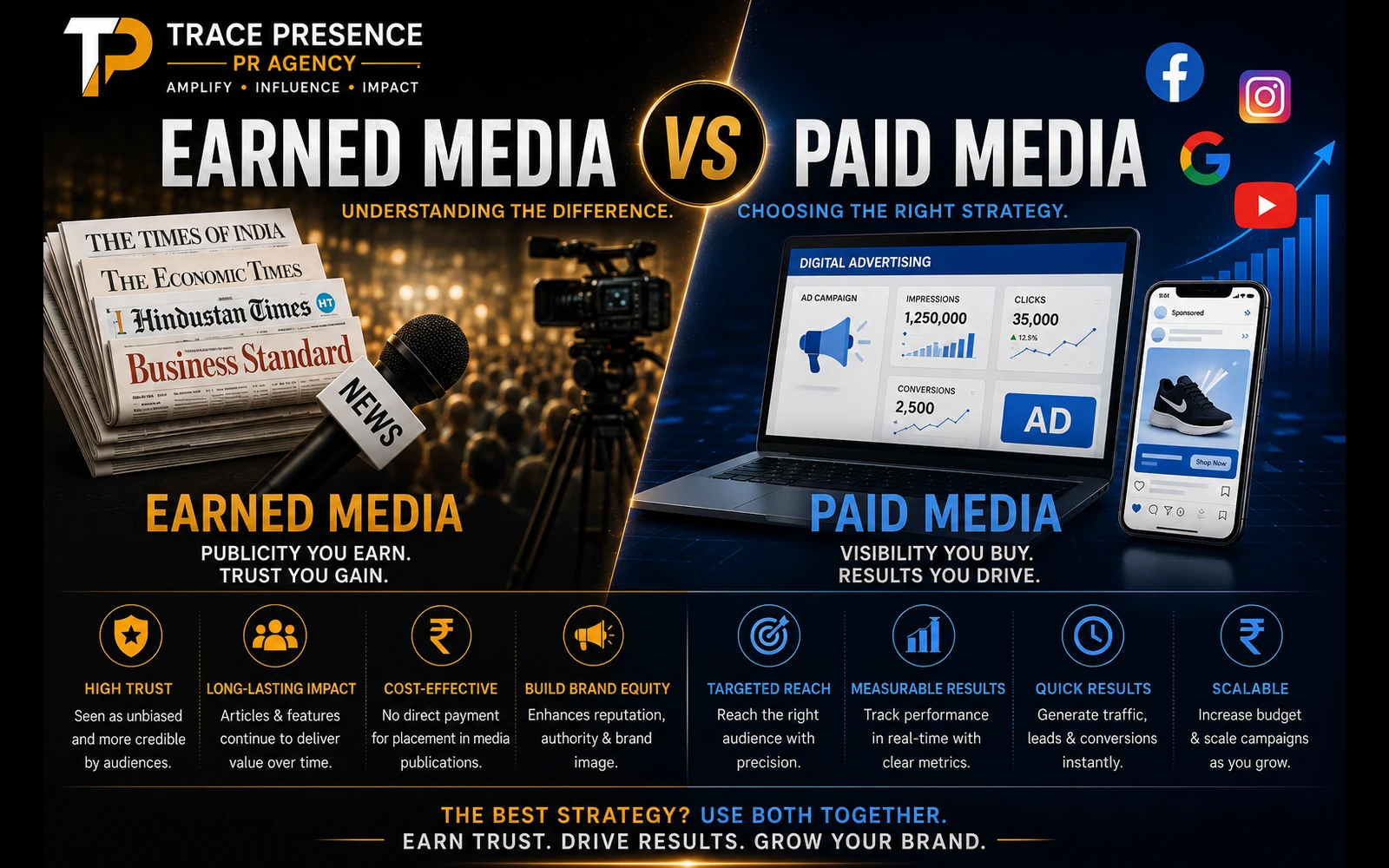
Earned media is coverage a third party chooses to give you: a journalist writing about your company, a business publication profiling your founder, a TV anchor inviting you on a panel, a podcast host giving you an hour. You do not control the final output, and that is precisely why it works — the audience knows nobody paid for the opinion.
Earned media includes editorial features in outlets like Forbes India and Economic Times, quotes in industry stories, TV interviews, podcast appearances, and organic mentions by creators. Our guide on how to get featured in Forbes India walks through what this looks like at the top tier.
What Is Paid Media?
Paid media is any placement you buy: performance ads on Google and Meta, sponsored articles, influencer promotions, and partnered brand content in publications. You control the message, the timing, and the scale. The audience, increasingly, knows exactly what it is.
Paid media is not the villain. It is unbeatable for measurable, immediate demand capture — nothing earns you a customer at 11pm tonight like a well-targeted ad. The problem starts when brands ask paid media to do credibility’s job.
The Credibility Gap: Why Ads Cannot Build Trust
Here is the pattern we see across Indian brands. A company spends lakhs per month on ads. Awareness rises, sales come in, and yet — when a big client, investor, or journalist Googles the founder, there is nothing there except the company’s own website and social profiles. The brand is visible but not credible.
Most brands do not have a visibility problem. They have a credibility problem. Advertising cannot fix that, because trust is transferred, not claimed. When a respected publication covers you, its credibility rubs off on you. When your own ad says you are excellent, no credibility changes hands at all.
This matters at very specific moments: enterprise deals where procurement teams research vendors, fundraising where investors run background checks, hiring senior talent, and increasingly, AI search answers — where tools like ChatGPT and Gemini recommend brands based largely on what credible third-party sources say about them.
Where Earned Media Falls Short
Honesty demands the other side too. Earned media is slow — a serious media presence takes months to build. It is not precisely targetable: you cannot choose who reads your Forbes feature the way you choose an ad audience. It is hard to attribute: no dashboard tells you which deal closed because of a TV interview. And a single feature, however prestigious, fades without follow-up. Earned media compounds only when it is consistent.
So a brand that relies on earned media alone will build reputation but may starve short-term demand. A brand that relies on paid alone will capture demand but stay fragile — one negative article can outweigh years of advertising, which is why handling negative news on Google becomes an emergency for ad-driven brands with no reputation reserve.
Cost Comparison: What Does Each Actually Cost in India?
Paid media pricing is transparent: you pay per click, per impression, or per placement, and costs rise every year as auctions get crowded. The moment you stop paying, the visibility stops — rent, not equity.
Earned media costs take the form of time and PR investment — either your own effort or an agency engagement. The output, however, behaves like an asset: a strong editorial feature keeps ranking for your name years later, keeps getting cited, and keeps working while you sleep. We break down typical agency pricing in our guide to PR agency costs in India, and the long-term maths in why one strong feature can beat months of ads.
How Smart Brands Sequence Both
Stage 1: Foundation (months 1–3)
Secure your first layer of credible coverage — digital publications, podcasts, industry quotes — so that anyone who searches your name finds third-party validation. Keep performance ads running for demand, but stop expecting them to build reputation.
Stage 2: Authority (months 3–9)
Push for bigger earned wins: business press features, TV panels, speaking slots. Now your ads convert better too, because the people they reach find a credible founder when they research you. Paid and earned start reinforcing each other instead of competing for budget.
Stage 3: Compounding (month 9 onwards)
Your media footprint starts generating inbound interest — journalists call you for quotes, event organisers invite you, AI tools cite you. Paid media becomes a scalpel for launches and campaigns rather than the only engine of growth.
Frequently Asked Questions
Which is better for a startup: earned media or paid media?
Early-stage startups usually need paid media for immediate demand and earned media for credibility with investors, partners, and senior hires. The mistake is treating them as substitutes — they answer different questions.
Is sponsored content earned media?
No. Sponsored or partnered articles are paid media because the brand buys the placement, and publications label them accordingly. They build visibility, but not third-party validation.
Why does earned media rank better on Google?
Editorial coverage sits on high-authority news domains that Google trusts, tends to earn links naturally, and stays live for years — so it dominates search results for your brand and founder name far longer than any campaign.
About Trace Presence
Trace Presence is a PR and marketing agency built on one principle: coverage that is earned, never bought. We help Indian founders and brands secure business press features, TV interviews, TEDx stages, and podcast appearances that build durable credibility. See our services or get in touch to plan your earned-media roadmap.