Earned media for founders and brands across India

Category: PR Strategy

Practical public relations strategy for Indian founders and brands.

  • Why One Strong Press Feature Beats Six Months of Ads

    Why One Strong Press Feature Beats Six Months of Ads

    Here is a spending pattern we see constantly: a brand burns Rs 3–5 lakh a month on ads for six months, pauses the budget, and watches revenue sag within weeks — while a competitor with one strong Forbes feature and a handful of interviews keeps closing deals off the credibility. The PR vs advertising ROI question is not really “which is better.” It is: which one are you underinvesting in, and why does one keep working after you stop paying?

    This article runs the honest maths: what each channel returns, over what timeframe, and why a single well-placed story can genuinely outperform months of advertising for certain — not all — business goals.

    The Fundamental Difference: Renting vs Owning Attention

    Advertising is rented attention. The meter runs while you pay, and stops when you stop — your CPMs rise yearly as auctions crowd, and nothing accumulates except (hopefully) customers. PR is owned reputation. A published feature, a TV clip, a podcast episode — these are permanent assets that keep appearing in searches, keep being cited, and keep transferring credibility long after the work was done. Neither is morally superior; they simply behave like different financial instruments. Ads are opex. Coverage is capex.

    What Advertising ROI Actually Looks Like

    Performance advertising is beautifully measurable, which is exactly why it dominates budgets: spend in, ROAS out, dashboards for everything. For demand capture — reaching someone who wants to buy tonight — it is unbeatable, and no PR campaign substitutes for it.

    But the measurable number hides three decaying curves. Ad costs in India have risen steadily every year as more brands compete for the same auctions. Creative fatigues in weeks, demanding constant production. And ad-driven trust is shallow: the moment a high-consideration buyer — an enterprise client, an investor, a franchisee — starts researching you, ads contribute nothing to what they find. That research moment is where deals are actually won or lost, and it belongs entirely to your earned footprint, as we unpacked in earned media vs paid media.

    What PR ROI Actually Looks Like

    PR returns arrive through four compounding channels, none of which fit neatly in a dashboard. Search equity: a feature in a credible publication ranks for your brand and founder name for years — thousands of high-intent searches will encounter it at zero marginal cost. Conversion lift: the same ad traffic converts measurably better when the research moment reveals third-party validation instead of silence; PR quietly raises the ROI of your advertising. Deal gravity: features function as references in fundraising, enterprise sales, and hiring — one Forbes India feature shown in a pitch meeting does work no ad can. Machine visibility: AI tools recommend brands based on credible third-party mentions, making earned coverage the primary input to AI search visibility — a channel that did not exist three years ago and is already shaping shortlists.

    The Honest Maths: One Feature vs Six Months of Ads

    Take a realistic mid-band comparison. Six months of moderate ad spend at Rs 2 lakh a month is Rs 12 lakh, producing traffic and sales that stop when the spend stops. A serious PR engagement over the same period — see our transparent breakdown of PR agency costs in India — might cost Rs 3–Rs 6 lakh and produce a handful of credible features, interviews, and a materially different Google page one.

    Now run both forward twenty-four months. The ad spend’s value at month 24 is whatever customers it captured — real, but finished. The coverage is still ranking, still being found by every investor and enterprise buyer who researches you, still feeding AI recommendations, and still lowering the effort of every subsequent media win, because journalists cover people who have been covered. That is the sense in which one strong feature beats six months of ads: not on next-week revenue — ads win that contest — but on cost per unit of durable trust, where it is not close.

    When Advertising Beats PR

    Credibility earns nothing if nobody needs your product. Advertising wins outright when the purchase is low-consideration and impulse-driven, when you need cashflow this quarter, when you are testing product-market fit and need fast signal, or when a launch window demands guaranteed reach on a fixed date. PR cannot guarantee timing or volume; pretending otherwise is how agencies lose clients’ trust.

    The Portfolio Answer

    Treat the two as a portfolio with different maturities. Ads are your short-duration instrument: predictable, liquid, immediately productive. PR is your long-duration compounding asset: slower to build, dramatically cheaper per impression over time, and the only channel that appreciates. The practical allocation we see work for growing Indian brands: keep performance spend at whatever efficiently captures existing demand, and carve out a consistent minority budget — often 15–25% of marketing — for building the earned layer, sequenced as we describe in our founder branding roadmap. Brands that run both stop debating ROI, because each channel visibly improves the other’s numbers.

    Frequently Asked Questions

    Is PR more effective than advertising in India?

    For durable trust, high-consideration sales, fundraising, and search presence — yes, rupee for rupee. For immediate, measurable demand capture, advertising wins. Mature brands run both, because coverage raises ad conversion and ads scale what coverage legitimises.

    How do you measure PR ROI?

    Track branded search volume, what page one of Google shows for your name, referral traffic and leads from coverage, conversion-rate lift during covered periods, inbound media and partnership requests, and mentions in AI tools — not vanity impressions.

    How long does PR take to show results?

    First placements typically land within one to three months, visible search-footprint change within three to six, and compounding effects — inbound journalists, easier bookings, AI citations — from six months onward. PR rewards consistency, not bursts.

    About Trace Presence

    Trace Presence is a PR and marketing agency built on one principle: coverage that is earned, never bought. We build the earned-media layer — business press features, TV interviews, TEDx stages, podcasts — that keeps working long after every campaign ends. Explore our services or talk to our team.

  • How to Make Your Brand Show Up in ChatGPT and AI Search Answers

    How to Make Your Brand Show Up in ChatGPT and AI Search Answers

    When someone asks ChatGPT “which PR agency should I hire in India?” or asks Gemini “best D2C skincare brands in India”, a brand gets recommended — and it is probably not yours. Brand visibility in AI search is becoming the new page one of Google: invisible to analytics, impossible to buy directly, and already influencing what customers shortlist before they ever visit a website.

    The good news: AI answers are not random. Models recommend brands based on identifiable signals, and those signals can be built deliberately. Here is how it works and what to do about it.

    How AI Tools Decide Which Brands to Mention

    Large language models like ChatGPT, Claude, and Gemini form their “opinions” from two layers. The first is training data — the enormous snapshot of the public web the model learned from, where brands that appear repeatedly in credible contexts become part of the model’s world-knowledge. The second is live retrieval — modern AI search (ChatGPT Search, Perplexity, Google’s AI Overviews) fetches current web pages and synthesises answers, heavily favouring sources it considers authoritative.

    Both layers reward the same underlying thing: third-party corroboration. A brand described as “leading” only on its own website is one voice. A brand mentioned across news features, industry roundups, directories, reviews, and interviews is a consensus — and models are consensus machines.

    Why Your Ads and Social Media Barely Register

    Paid ads are invisible to AI models — ad platforms do not feed training data, and retrieval systems skip sponsored slots. Social media helps less than founders assume: much of it is walled, ephemeral, or too noisy to constitute evidence. What models can see and weigh is the open, crawlable, credible web: news articles, editorial features, structured directories, review platforms, podcasts with indexed transcripts, and well-organised websites. This is why earned media has quietly become an AI-visibility strategy, not just a credibility play.

    The Six Signals That Get Brands Into AI Answers

    1. Coverage in credible publications

    News and business press features are the strongest signal, because models treat established outlets as high-trust sources. A Forbes India feature or an Economic Times mention does double duty: it persuades humans and teaches machines.

    2. Presence in comparison and roundup content

    When a retrieval system answers “best X in India”, it leans on existing listicles, comparisons, and directories. Auditing which roundups exist in your category — and earning your way into them — directly shapes AI recommendations.

    3. A crawlable, well-structured website

    Clear service descriptions, FAQ sections that answer real questions in plain language, schema markup, and consistent NAP (name, address, positioning) details make your site quotable. Pages written like answers get used as answers.

    4. Consistent entity information

    Models build an “entity” for your brand from every mention across the web. Conflicting descriptions, old positioning, or a founder bio that differs across platforms blur that entity. Alignment across your site, LinkedIn, directories, and press coverage sharpens it.

    5. Reviews and community mentions

    Google reviews, industry platforms, and genuine community discussions (Reddit, Quora, forums) feed both training and retrieval. Fake reviews are a losing game; systematically asking happy customers to write real ones is not.

    6. Freshness

    Retrieval-based AI favours recent content. A brand whose last press mention is from 2023 fades from answers even if it once dominated. Sustained coverage cadence — the same discipline that powers compounding PR returns — keeps you in the answer set.

    How to Audit Your Current AI Visibility

    Run your category’s buying questions through ChatGPT, Gemini, and Perplexity: “best [your category] in India”, “top [your category] for [use case]”, “[your brand] review”. Note three things: whether you appear, how you are described, and which sources the tools cite. Those citations are your target list — the specific pages and publications you need to be present in. Repeat monthly; AI answers shift as the underlying web shifts.

    A Realistic 90-Day Plan

    Days 1–30: fix your owned layer — rewrite site pages as clear answers, add FAQ schema, align every profile and directory listing to one consistent description. Days 31–60: earn your evidence layer — pitch two or three credible publications, target the roundups AI tools currently cite, and get the founder on one or two indexed podcasts. Days 61–90: build the freshness habit — a monthly cadence of coverage, reviews, and content updates. Most brands see their first AI-answer appearances within one to two quarters, because retrieval-based tools update fast even while training data lags.

    Frequently Asked Questions

    Can you pay to appear in ChatGPT or Gemini answers?

    No. There is no ad product that inserts brands into organic AI answers. Visibility comes from the open web evidence models read — press coverage, roundups, reviews, and well-structured sites — which is earned, not bought.

    How do I check if AI tools mention my brand?

    Ask ChatGPT, Gemini, and Perplexity the buying questions your customers ask — “best [category] in India” — plus direct brand queries. Record whether you appear, how you are described, and which sources are cited, then repeat monthly.

    Does traditional SEO still matter for AI search?

    Yes — arguably more. Retrieval-based AI tools pull from pages that rank and parse well. Strong technical SEO, clear structure, and authoritative backlinks make your content the raw material AI answers are built from.

    About Trace Presence

    Trace Presence is a PR and marketing agency built on one principle: coverage that is earned, never bought. We build the press coverage, digital footprint, and entity consistency that get brands cited in Google and AI search answers alike. Explore our services or ask us for an AI-visibility audit.

  • Festive Season PR in India: How to Plan Coverage Before Diwali 2026

    Festive Season PR in India: How to Plan Coverage Before Diwali 2026

    Quick answers

    Frequently asked questions

    When should festive PR planning start in India?

    Six to eight weeks before the peak. For Diwali on 8 November 2026, that means the angle should be settled by mid-September and pitching underway by the end of that month.

    Is festive PR only for consumer brands?

    No. B2B businesses in logistics, payments, packaging, lending and retail technology all have strong seasonal stories, and they face far less competition for a journalist’s attention.

    What if I have missed the window this year?

    Pivot to the post-festive period. Year-end round-ups and outlook pieces are commissioned through late November and December, and competition is much lower.

    Does festive coverage actually drive sales?

    It rarely creates demand on its own. What it does is make you a credible option during a period when buyers are already deciding, which matters more in a crowded season.

    Should I use paid or earned media during the festive season?

    Advertising rates peak in October, which makes earned coverage relatively better value — provided you started early enough to secure it.

    Between Navratri in mid-October and Diwali on 8 November 2026, Indian consumer attention concentrates more sharply than at any other point in the year. Media schedules fill, editors plan ahead, and brands that started late end up buying whatever inventory is left.

    If you want coverage during the festive season, the planning window is now. This is a practical timeline, written in August 2026, for founders and marketing heads who need their story in the press before the season peaks.

    Why festive PR is planned earlier than founders expect

    Newsrooms work ahead. Festive features, gift guides, sector round-ups and trend pieces are commissioned weeks before they publish. By the time consumers are shopping, the journalism about that shopping was already written.

    The brands you read about during Diwali pitched their story in September.

    Three things happen simultaneously as the season approaches, and all three work against latecomers.

    • Editorial calendars close. Festive features get locked in early, and there is no room added later.
    • Competition rises sharply. Every consumer brand in the country is pitching the same journalists at the same time.
    • Advertising costs climb. Paid media rates rise steeply through October, so earned coverage becomes relatively more valuable.

    The 2026 festive calendar, and what to do when

    DateOccasionWhat you should be doing
    14 SeptemberGanesh ChaturthiFestive angle finalised; first pitches out
    Mid-late SeptemberPre-festive planningApproach monthly magazines and long-lead publications
    Early OctoberNavratri approachesPitch daily press and digital publications
    20 OctoberDussehraCoverage should be running; podcasts and TV slots confirmed
    Late OctoberPeak shoppingAmplify what has published; nothing new gets commissioned
    8 NovemberDiwaliCampaign peak; be visible, not pitching
    15 NovemberChhath PujaRegional coverage window, especially in the east
    Late NovemberPost-festiveResults stories and year-end round-ups

    The single most useful line in that table is the last row of October. After roughly the third week of October, most editors have what they need. Pitching after that is largely wasted effort.

    What actually gets covered during the festive season

    Editors are not short of brands wanting festive coverage. They are short of festive stories that are not advertisements. The angles that get commissioned tend to be:

    • Data about how India is spending differently this year. If you have transaction data, category data or regional patterns, that is a story.
    • A genuine shift in consumer behaviour you can evidence from your own business.
    • The people behind the season — artisans, small manufacturers, logistics workers, the supply chain nobody photographs.
    • A counter-narrative. Brands doing less, spending less, or opting out often get more coverage than brands shouting louder.
    • Regional specificity. National outlets are saturated; regional publications are far more open and often closer to your buyer.

    What does not get covered: your festive discount, your new festive packaging, or your festive campaign film. Those are advertising, and there is a separate desk for that.

    A realistic six-week plan

    Weeks 1 to 2 — Find the angle

    Look at your own numbers first. What is different this year compared to last? Which category is growing that nobody expected? Which region is behaving unusually? Your data is the most defensible story you have, and nobody else can pitch it.

    Weeks 3 to 4 — Build the list and pitch long-lead

    Identify the specific journalists covering your sector, not just the publications. Monthly magazines and long-lead digital features need to hear from you first. Keep the pitch to a subject line that reads like a headline and three lines of substance.

    Week 5 — Daily press and digital

    Shorter lead times, faster decisions, higher volume. This is also the window for podcast bookings, since episodes recorded now will publish during the season.

    Week 6 — Television and amplification

    Business channels look for festive segments with a data angle. If you have numbers on festive spending in your category, that is a viable pitch. Meanwhile, amplify everything that has already published.

    The mistakes that waste festive budgets

    • Starting in October. By then the features are written. You are competing for scraps.
    • Pitching a discount as news. It is not, and pitching it marks you as someone who does not read the publication.
    • Ignoring regional media. A story in a leading regional daily often reaches more actual buyers than a national mention.
    • One big push, nothing after. The post-Diwali window is quiet and unusually easy to get coverage in.
    • Forgetting the follow-through. Coverage that nobody amplifies does a fraction of the work it could.

    What to do after the season ends

    Late November and December are among the easiest months of the year to earn coverage. Newsrooms are planning year-end round-ups and next-year outlooks, and far fewer brands are pitching. If your festive campaign produced real results, that becomes a story in itself — and it is a story with data, which editors prefer.

    Start with one question

    What is true about your business this festive season that was not true last year? If you can answer that with a number, you have a story. If you cannot, you have an advertisement, and that needs a different budget line.

    Trace Presence is a PR and marketing agency in India working with founders and brands on earned coverage across national press, television, podcasts and regional media. If the festive window matters to your business, the time to plan it is now.

  • Earned Media vs Paid Media: Which Actually Builds Credibility?

    Earned Media vs Paid Media: Which Actually Builds Credibility?

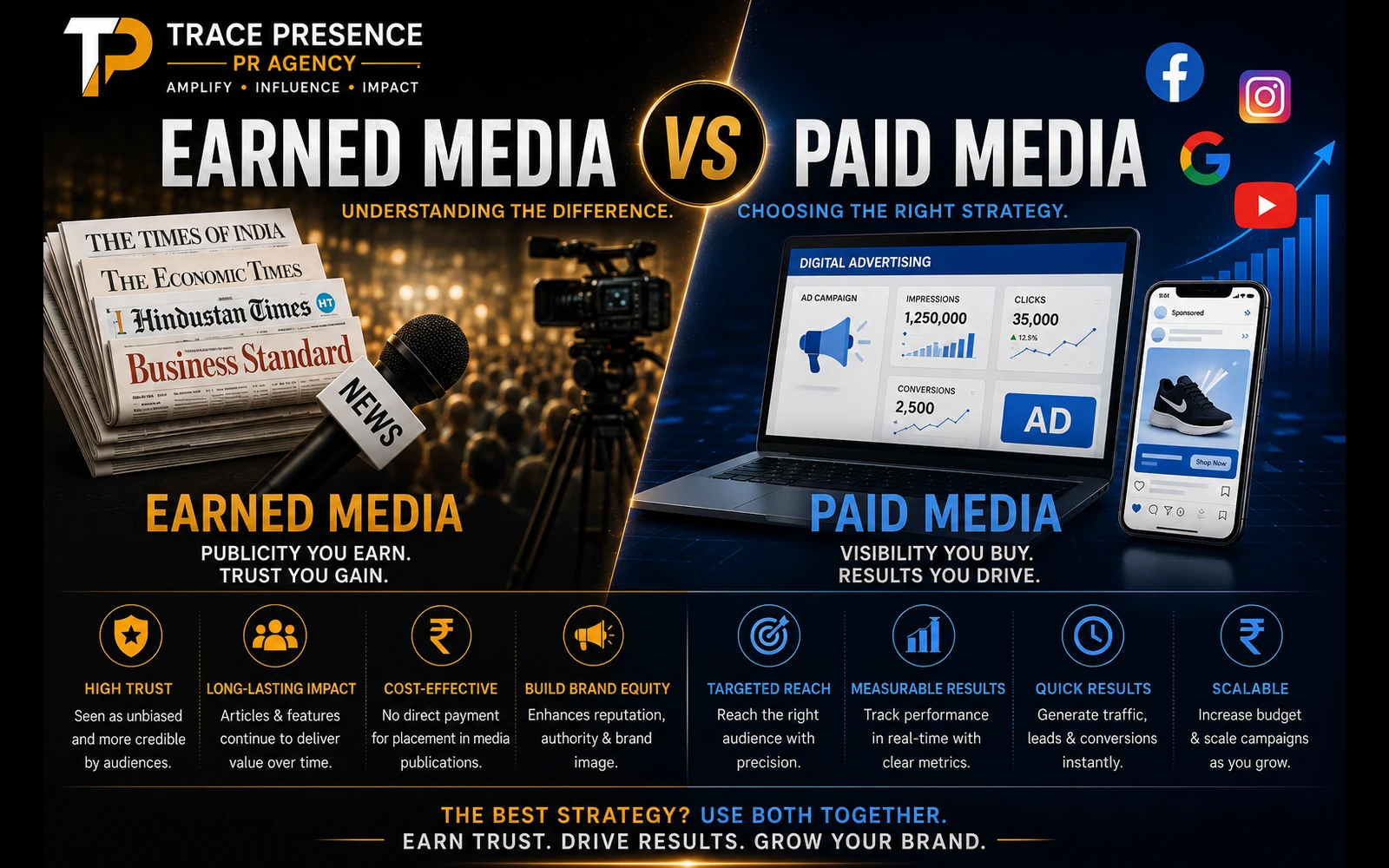
    Marketing budgets in India are being questioned harder than ever, and the debate almost always lands on the same comparison: earned media vs paid media. One promises credibility you cannot buy; the other promises reach you can switch on tomorrow morning. Founders are routinely told they must choose. The truth is more useful: they do different jobs, and confusing those jobs is why so many brands burn money without building trust.

    This article explains what each one actually delivers, when paid media quietly fails, when earned media is genuinely not enough, and how Indian brands should sequence the two.

    What Is Earned Media?

    Earned media is coverage a third party chooses to give you: a journalist writing about your company, a business publication profiling your founder, a TV anchor inviting you on a panel, a podcast host giving you an hour. You do not control the final output, and that is precisely why it works — the audience knows nobody paid for the opinion.

    Earned media includes editorial features in outlets like Forbes India and Economic Times, quotes in industry stories, TV interviews, podcast appearances, and organic mentions by creators. Our guide on how to get featured in Forbes India walks through what this looks like at the top tier.

    What Is Paid Media?

    Paid media is any placement you buy: performance ads on Google and Meta, sponsored articles, influencer promotions, and partnered brand content in publications. You control the message, the timing, and the scale. The audience, increasingly, knows exactly what it is.

    Paid media is not the villain. It is unbeatable for measurable, immediate demand capture — nothing earns you a customer at 11pm tonight like a well-targeted ad. The problem starts when brands ask paid media to do credibility’s job.

    The Credibility Gap: Why Ads Cannot Build Trust

    Here is the pattern we see across Indian brands. A company spends lakhs per month on ads. Awareness rises, sales come in, and yet — when a big client, investor, or journalist Googles the founder, there is nothing there except the company’s own website and social profiles. The brand is visible but not credible.

    Most brands do not have a visibility problem. They have a credibility problem. Advertising cannot fix that, because trust is transferred, not claimed. When a respected publication covers you, its credibility rubs off on you. When your own ad says you are excellent, no credibility changes hands at all.

    This matters at very specific moments: enterprise deals where procurement teams research vendors, fundraising where investors run background checks, hiring senior talent, and increasingly, AI search answers — where tools like ChatGPT and Gemini recommend brands based largely on what credible third-party sources say about them.

    Where Earned Media Falls Short

    Honesty demands the other side too. Earned media is slow — a serious media presence takes months to build. It is not precisely targetable: you cannot choose who reads your Forbes feature the way you choose an ad audience. It is hard to attribute: no dashboard tells you which deal closed because of a TV interview. And a single feature, however prestigious, fades without follow-up. Earned media compounds only when it is consistent.

    So a brand that relies on earned media alone will build reputation but may starve short-term demand. A brand that relies on paid alone will capture demand but stay fragile — one negative article can outweigh years of advertising, which is why handling negative news on Google becomes an emergency for ad-driven brands with no reputation reserve.

    Cost Comparison: What Does Each Actually Cost in India?

    Paid media pricing is transparent: you pay per click, per impression, or per placement, and costs rise every year as auctions get crowded. The moment you stop paying, the visibility stops — rent, not equity.

    Earned media costs take the form of time and PR investment — either your own effort or an agency engagement. The output, however, behaves like an asset: a strong editorial feature keeps ranking for your name years later, keeps getting cited, and keeps working while you sleep. We break down typical agency pricing in our guide to PR agency costs in India, and the long-term maths in why one strong feature can beat months of ads.

    How Smart Brands Sequence Both

    Stage 1: Foundation (months 1–3)

    Secure your first layer of credible coverage — digital publications, podcasts, industry quotes — so that anyone who searches your name finds third-party validation. Keep performance ads running for demand, but stop expecting them to build reputation.

    Stage 2: Authority (months 3–9)

    Push for bigger earned wins: business press features, TV panels, speaking slots. Now your ads convert better too, because the people they reach find a credible founder when they research you. Paid and earned start reinforcing each other instead of competing for budget.

    Stage 3: Compounding (month 9 onwards)

    Your media footprint starts generating inbound interest — journalists call you for quotes, event organisers invite you, AI tools cite you. Paid media becomes a scalpel for launches and campaigns rather than the only engine of growth.

    Frequently Asked Questions

    Which is better for a startup: earned media or paid media?

    Early-stage startups usually need paid media for immediate demand and earned media for credibility with investors, partners, and senior hires. The mistake is treating them as substitutes — they answer different questions.

    Is sponsored content earned media?

    No. Sponsored or partnered articles are paid media because the brand buys the placement, and publications label them accordingly. They build visibility, but not third-party validation.

    Why does earned media rank better on Google?

    Editorial coverage sits on high-authority news domains that Google trusts, tends to earn links naturally, and stays live for years — so it dominates search results for your brand and founder name far longer than any campaign.

    About Trace Presence

    Trace Presence is a PR and marketing agency built on one principle: coverage that is earned, never bought. We help Indian founders and brands secure business press features, TV interviews, TEDx stages, and podcast appearances that build durable credibility. See our services or get in touch to plan your earned-media roadmap.

  • How Much Does PR Cost in India? An Honest Pricing Breakdown

    How Much Does PR Cost in India? An Honest Pricing Breakdown

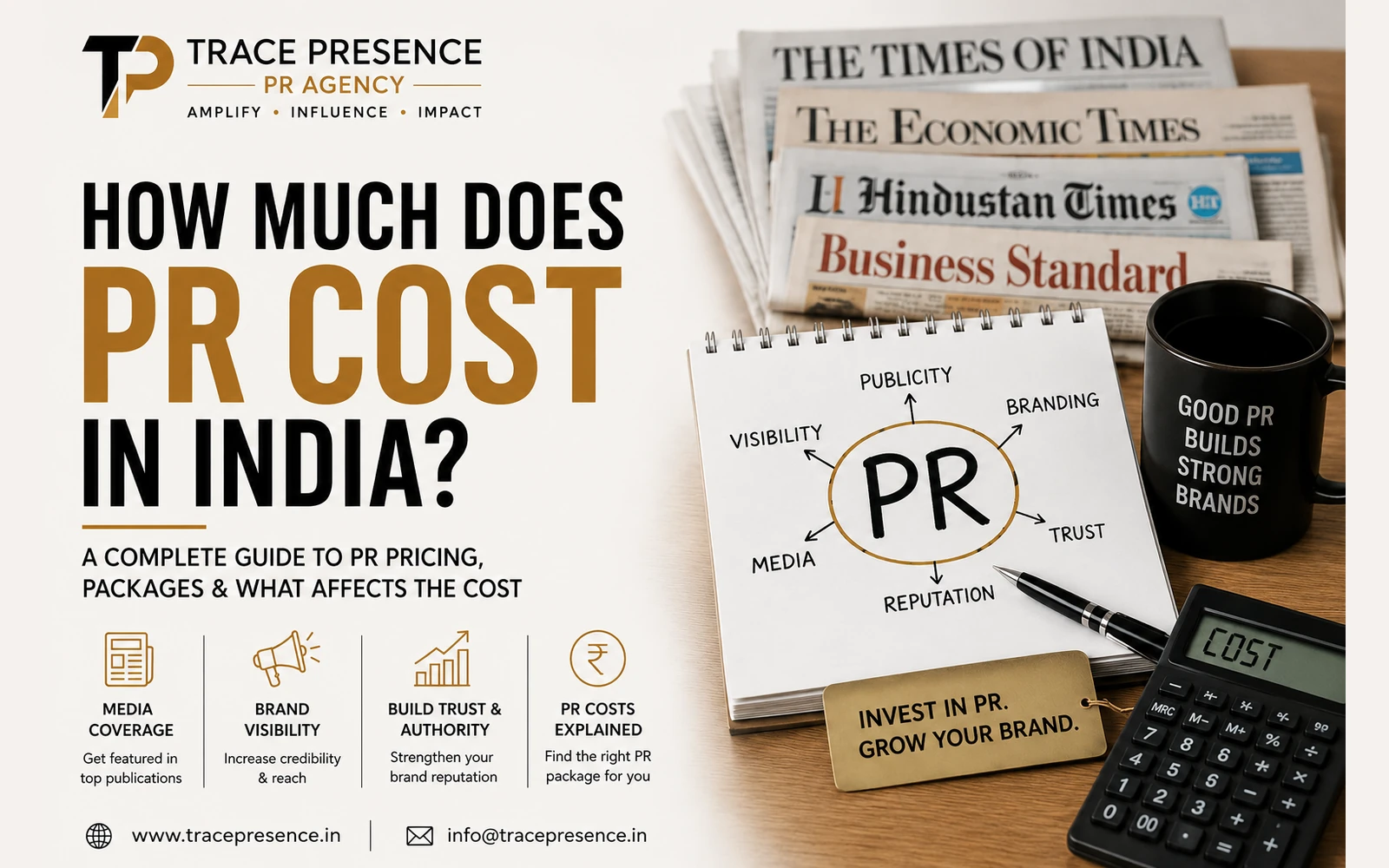
    Ask ten agencies about PR agency cost in India and you will get ten confident, completely different answers. Some quote Rs 25,000 a month, some quote Rs 5 lakh, and almost nobody explains what actually drives the difference. That opacity suits agencies. It does not suit you.

    This guide gives you the honest numbers: what PR genuinely costs in India in 2026, what you get at each price band, the hidden costs nobody mentions in the proposal, and how to judge whether you are overpaying.

    What Does PR Actually Cost in India in 2026?

    Indian PR pricing broadly falls into four bands. Treat these as market ranges, not rate cards — city, sector, and agency pedigree all move the needle.

    Freelancers and solo consultants: Rs 15,000–Rs 50,000 per month

    A freelancer with genuine media contacts can get a startup its first mentions and quotes. What you sacrifice is bandwidth and breadth — one person can only know so many journalists, and coverage usually stays limited to their existing circle.

    Boutique agencies: Rs 50,000–Rs 1.5 lakh per month

    This is the sweet spot for most funded startups and growing SMEs. A boutique team typically delivers consistent digital publication coverage, business press pitching, founder positioning, and podcast or speaking placements. Senior people actually work on your account rather than just appearing in the pitch meeting.

    Mid-size firms: Rs 1.5–Rs 4 lakh per month

    You are paying for structured processes, multi-city media reach, crisis preparedness, and dedicated account teams. Appropriate when you have regular news flow — funding rounds, launches, expansion — that justifies always-on media engagement.

    Large network agencies: Rs 4–Rs 10+ lakh per month

    Global networks bring scale, international coordination, and board-level counsel. For most Indian founders reading this, this tier is more machinery than they need — you can end up as a small account inside a very large machine.

    Retainer vs Project vs Pay-Per-Placement

    Monthly retainers dominate the industry because media relationships need continuity. Most agencies insist on three to six month minimums, and that is fair — earned coverage compounds, as we explain in our comparison of earned media vs paid media.

    Project pricing suits defined events: a launch, a funding announcement, a rebrand. Expect Rs 75,000–Rs 3 lakh depending on scope. It works when you have one story, not when you are building a reputation.

    Pay-per-placement — paying per article secured — sounds fair but deserves caution. It pushes agencies toward guaranteed paid placements dressed up as coverage, and it prices media relationships like commodities. If an agency “guarantees” specific editorial coverage in named publications, ask hard questions about how. Genuine editorial, like a Forbes India feature, cannot be guaranteed by anyone honest.

    What Actually Drives the Price Up or Down?

    Four factors explain most of the variance between quotes. First, seniority of the team on your account — the person pitching your story matters more than the agency logo. Second, scope of media targets: national business press and TV cost more effort than trade portals. Third, content production: some retainers include ghostwritten thought leadership, others bill it separately. Fourth, crisis coverage: reputation defence, like managing negative news on Google, is typically a separate, urgent engagement billed at premium rates — often Rs 1–Rs 5 lakh per situation depending on severity.

    The Hidden Costs Nobody Puts in the Proposal

    Budget for these before you sign anything. Paid feature placements, if you choose them, are billed by publications separately — anywhere from Rs 20,000 for smaller portals to several lakh for premium brand-content programs. Professional photography and video for media kits. Event and awards entry fees. And your own time: PR fails without founder availability for interviews, quotes, and reactive commentary. An agency can open the door, but you still have to walk through it — prepared. Our guide on getting TV interviews in India shows what that preparation looks like.

    How to Know If You Are Overpaying

    Three tests cut through most confusion. The output test: over three months, has your Google footprint visibly improved when someone searches your name and brand? The access test: do you talk to the senior person who pitched you, or did your account get handed to a trainee? The strategy test: does the agency push back on weak stories, or does it happily pitch whatever you ask? An agency that never says no is billing you for activity, not results.

    What Should You Pick at Your Stage?

    Bootstrapped and pre-revenue: start with founder-led PR plus a consultant for targeted placements — your story is your scarcest asset, so build it around personal branding first. Funded startups: a boutique retainer in the Rs 50,000–Rs 1.5 lakh band usually maximises coverage per rupee. Established brands with continuous news flow: mid-size retainers earn their keep. And whatever the stage — insist on monthly reporting that shows coverage secured, not “impressions delivered.”

    Frequently Asked Questions

    How much does a PR agency cost per month in India?

    Freelancers charge Rs 15,000–Rs 50,000, boutique agencies Rs 50,000–Rs 1.5 lakh, mid-size firms Rs 1.5–Rs 4 lakh, and large network agencies Rs 4 lakh and above per month. Most funded startups get the best value in the boutique band.

    Do PR agencies guarantee media coverage?

    Genuine editorial coverage cannot be guaranteed — journalists decide what they publish. Agencies that guarantee named publications are usually selling paid placements, which are legitimate but different and should be priced transparently.

    Is PR worth it for a small business in India?

    Yes, when timed right. If customers, partners, or investors research you before buying, even a modest earned-media footprint measurably improves conversion. If nobody researches you before purchase, spend on demand generation first.

    What is the minimum contract period for PR agencies?

    Most Indian agencies ask for three to six month minimum retainers, because earned media takes time to build. Be wary of both twelve-month lock-ins with no exit clause and agencies happy to bill month-to-month with no plan.

    About Trace Presence

    Trace Presence is a PR and marketing agency built on one principle: coverage that is earned, never bought. We work with Indian founders and brands on business press features, TV interviews, TEDx positioning, and reputation management — with transparent pricing and reporting that shows real coverage, not vanity metrics. Explore our services or request a quote.