
Quick answers
Frequently asked questions
Is a TV interview more valuable than a podcast?
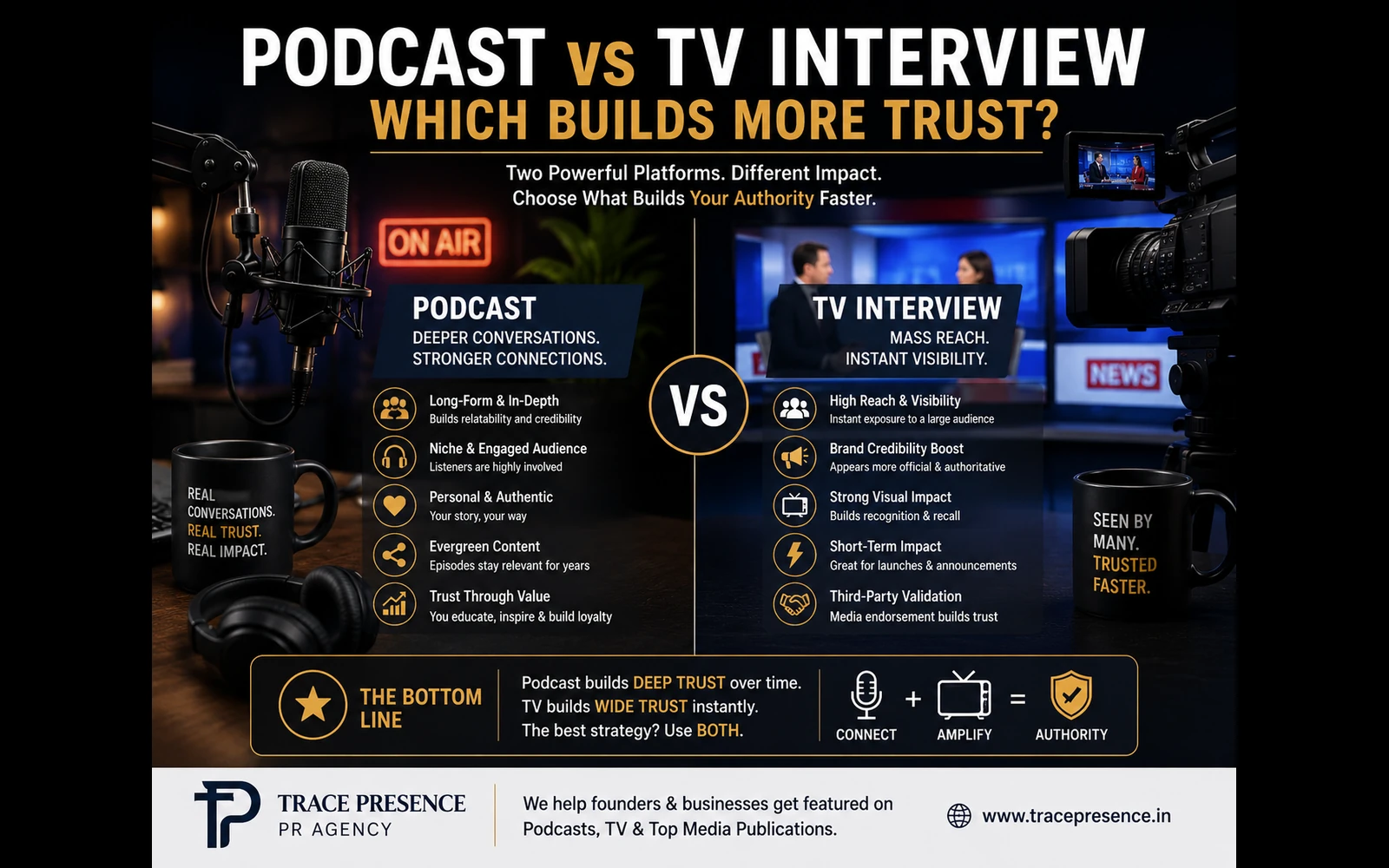
Neither is more valuable in general. Television builds authority faster; podcasts build trust deeper. Which is more valuable depends entirely on whether your current problem is credibility or understanding.
Can I use a TV interview clip in marketing?
Usually yes for short excerpts with attribution, but broadcast footage is copyrighted and rules vary by channel. Ask the channel what usage they permit before you build a campaign around it.
How long should I prepare for a TV interview?
Considerably longer than the interview itself. For a four-minute slot, expect several hours of message preparation and practice compressing each point to about fifteen seconds.
Do podcasts help SEO?
Indirectly but genuinely. Episode pages, show notes and transcripts create indexed mentions of your name and company, which strengthens how you appear in search results and increasingly in AI-generated answers.
Should a small business bother with either?
Yes, starting with podcasts. Smaller and sector-specific shows actively want guests, and the audience is often exactly the buyer a small business is trying to reach.
Founders ask us this constantly: if there is budget and time for one, should it be a podcast or a television interview? The honest answer is that they do completely different jobs, and picking wrongly wastes both.
Here is a straight comparison, based on what actually happens after each one runs.
The short answer
| Podcast | TV interview | |
|---|---|---|
| Builds | Familiarity and depth | Authority and legitimacy |
| Length | 30 to 90 minutes | 90 seconds to 8 minutes |
| Audience | Small, self-selected, highly relevant | Large, general, mostly passive |
| Shelf life | Years | Hours, unless you clip it |
| Control of message | High | Very low |
| Preparation needed | Moderate | Heavy |
| Best for | Explaining something complex | Being taken seriously quickly |
What a podcast actually does for you
A podcast gives you time. That is its entire advantage, and it is a big one.
In forty minutes a listener hears how you think, not just what you sell. They hear you hesitate on a hard question and answer it anyway. By the end, a stranger has formed an opinion about whether they trust you — which is precisely the thing that closes deals later.
- Listeners chose the topic, so intent is high
- Episodes are indexed and keep being found for years
- Transcripts feed search results and AI-generated answers
- You can explain nuance that a headline destroys
- Clips give you months of social content from one recording
The trade-off is reach. A good Indian business podcast might have a few thousand engaged listeners. That is not a mass-market number, and it is not supposed to be.
What a TV interview actually does for you
Television gives you legitimacy. Not because more people watch — often fewer people watch closely than you would expect — but because of what appearing on it signals.
A podcast makes people trust you. Television makes people assume others already do.
That signal is disproportionately useful in specific situations: raising money, entering a market where nobody knows you, negotiating with larger partners, or recovering from a reputational knock.
- The clip is a permanent credibility asset for decks and profiles
- It carries weight with people outside your industry, including family offices and government
- Other journalists notice; TV appearances often lead to more press
- It is very hard to fake, so it is trusted
The trade-off is control. You may get four minutes, an anchor with a different agenda, and a question you did not expect. There is no editing and no second take.
Where founders get this wrong
Mistake 1 — Chasing TV before having anything to say
Television rewards people who can compress a point into fifteen seconds. If you have not practised that, a national interview will expose it in front of the largest possible audience. Podcasts are the training ground.
Mistake 2 — Treating a podcast like a pitch
The founders who get the most from podcasts are the ones who forget they are marketing. Listeners can hear a sales pitch instantly and they leave.
Mistake 3 — Doing one of each and stopping
Neither format works as a single event. Both are cumulative. One appearance is a rehearsal; a body of appearances is a reputation.
Which should you do first?
For most Indian founders, in most situations, the sequence is:
- Start with podcasts. Lower stakes, longer format, and you learn how you sound.
- Build three to five appearances. You will get noticeably better, and you will have clips.
- Then approach television. Bookers can see you handle an interview, which makes you a safer choice.
- Run both together after that. Podcasts for depth, television for legitimacy.
There are exceptions. If your company is in the news this week for a genuine reason, take the television slot now — news windows close fast. If you are raising and need a credibility signal within the month, television moves quicker.
How to decide, honestly
| Your situation | Go with |
|---|---|
| Complex product nobody understands | Podcast |
| Raising a round in the next quarter | TV interview |
| Building a personal brand over 12 months | Podcast, consistently |
| Entering a market where you are unknown | TV interview |
| Recovering from negative coverage | TV interview, carefully prepared |
| Selling to a niche technical audience | Podcast |
| You have never done a media interview | Podcast first, without exception |
The short version
Podcasts are how people come to trust you. Television is how people assume you are already trusted. Most founders need the first before the second will work properly.
Trace Presence is a PR and marketing agency in India that arranges both — podcast appearances and national television interviews — with briefing support before you go on air.