
Quick answers
Frequently asked questions
How do I find podcasts that accept guests in India?
Start with the shows your customers already listen to, then search your sector plus “podcast” on Spotify and YouTube. Newer shows and sector-specific shows are far more open to first-time guests than large general ones.
Do I have to pay to be on a podcast?
Genuine guest appearances are free — hosts need good guests. Some shows sell sponsored guest slots, which is advertising rather than an interview. Both exist; know which one you are being offered.
What if I am not a good speaker?
Start with smaller, pre-recorded shows where mistakes can be edited out. Speaking on podcasts is a skill that improves quickly with reps, and the early episodes almost nobody hears.
How many podcasts should a founder do?
Consistency beats volume. One thoughtful appearance a month for a year does considerably more than ten in a single quarter followed by silence.
Are podcasts better than press coverage?
They do different jobs. Press coverage gives you credibility that can be verified and cited. Podcasts give you familiarity and depth. Founders who do well usually build both.
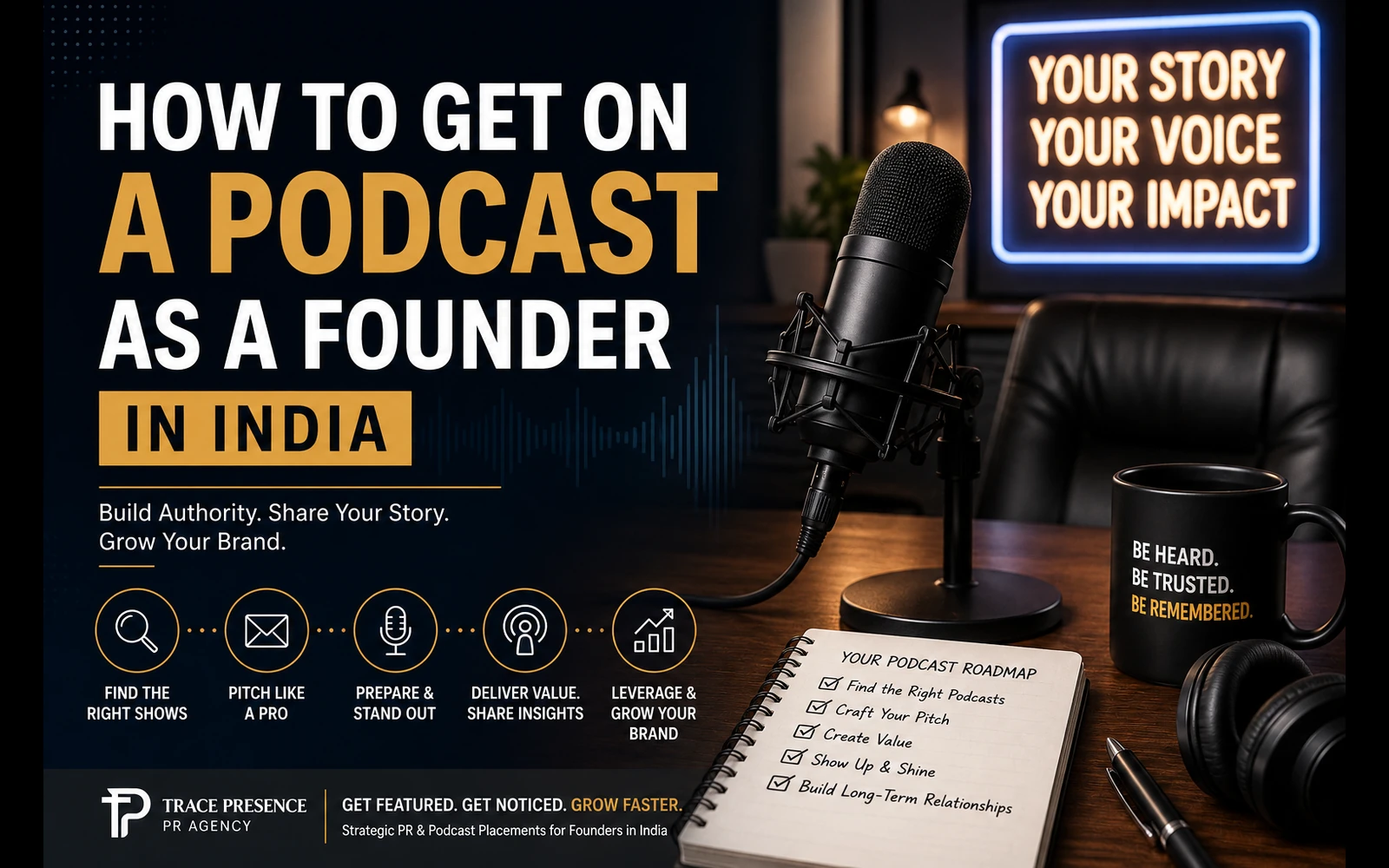
Podcasts have quietly become the most useful media format for Indian founders. An article gives you a paragraph. A podcast gives you forty minutes in someone’s ear while they drive, walk or cook — and people remember voices in a way they do not remember press releases.
This guide covers how founders actually get booked on podcasts in India, what hosts are really looking for, and what to do once you are on.
Why podcasts work differently to other coverage
Most PR gives you exposure. Podcasts give you familiarity, which is a different and more valuable thing.
- Length. Forty minutes lets you explain nuance that a 400-word article cannot hold.
- Voice. Listeners form a judgement about whether they like you, not just what you do.
- Intent. Nobody stumbles onto a podcast. They chose the subject, which means they care.
- Shelf life. Episodes keep getting discovered for years. A news article is dead in three days.
- Searchability. Transcripts are indexed, so your name starts appearing in searches — including in AI-generated answers.
The uncomfortable truth about getting booked
Hosts are not looking for guests. They are looking for episodes their audience will finish. Those are not the same thing.
Every host is asking one silent question: will my listeners still be listening at minute twenty?
This is why “I would like to come on your podcast to talk about my company” almost never works. It answers your need, not theirs.
What hosts actually want from a guest
| What founders offer | What hosts want instead |
|---|---|
| Company background | A specific story with tension and a turn |
| Industry overview | A contrarian view they can push back on |
| Product explanation | Numbers and lessons the audience can use |
| Founder journey, generally | One decision that nearly went wrong |
| Availability | A guest who will promote the episode afterwards |
How to get on a podcast: the actual process
Step 1 — Build a shortlist that fits your audience, not your ego
The biggest show is rarely the best show. A podcast with 2,000 listeners who are all founders in your sector is worth more than one with 200,000 general listeners. Start with:
- Shows your customers already mention
- Sector podcasts in your industry
- Regional shows in your city or state
- Newer shows actively looking for guests — these are the easiest first wins
Step 2 — Listen properly before you pitch
Listen to at least three full episodes. You need to know the format, the length, how the host handles guests, and what has already been covered. Pitching a topic they did last month is the fastest way to get ignored.
Step 3 — Pitch the episode, not yourself
Write your pitch as though you are proposing a finished episode. A structure that works:
- One line on why now. What has changed in your market that makes this timely.
- Three specific talking points. Not themes — actual questions you can answer with substance.
- Proof you are worth the airtime. A number, an outcome, a decision with consequences.
- One line of credentials. At the bottom, short.
- A clear offer to promote. Tell them you will share the episode with your list and network.
Step 4 — Make the host’s job effortless
Send a short guest sheet with your name spelled correctly, a one-line bio, a headshot, and three questions you would love to be asked. Hosts remember guests who reduce their workload, and they recommend them to other hosts.
Step 5 — Turn one appearance into three
This is where most founders stop, and where the value actually is. After the episode goes live:
- Clip two or three 45-second moments for LinkedIn and Instagram
- Write a short post about one idea from the conversation
- Add the episode to your website and email signature
- Send it to the next host as proof you are a good guest
What to do in the interview itself
- Answer in stories, not statements. “We grew fast” is forgettable. “We had eleven days of runway” is not.
- Use real numbers. Specificity signals honesty.
- Admit something. Guests who only talk about wins sound like advertising.
- Do not pitch. One mention of what you do, at the end, if asked.
- Let silences sit. Editors keep the pauses that come before honest answers.
How long before this does anything for your business?
Podcasts are a compounding channel, not a lead tap. Realistically:
| Timeframe | What to expect |
|---|---|
| First episode | Almost nothing measurable. Treat it as practice |
| 3 to 5 episodes | Your name starts appearing in searches; inbound conversations mention them |
| 8 to 12 episodes | Hosts begin approaching you; other media start noticing |
| 12 months+ | A body of work that does credibility work for you without you present |
If a founder does one podcast and calls the channel useless, they have measured a rehearsal.
Where to start this week
Pick three podcasts your customers actually listen to. Listen to one full episode of each. Write one pitch, for the smallest of the three. That is the whole first step.
Trace Presence is a PR and marketing agency in India that places founders on podcasts, on national television and in leading publications. If you want help identifying the right shows and getting booked, we are happy to talk.