
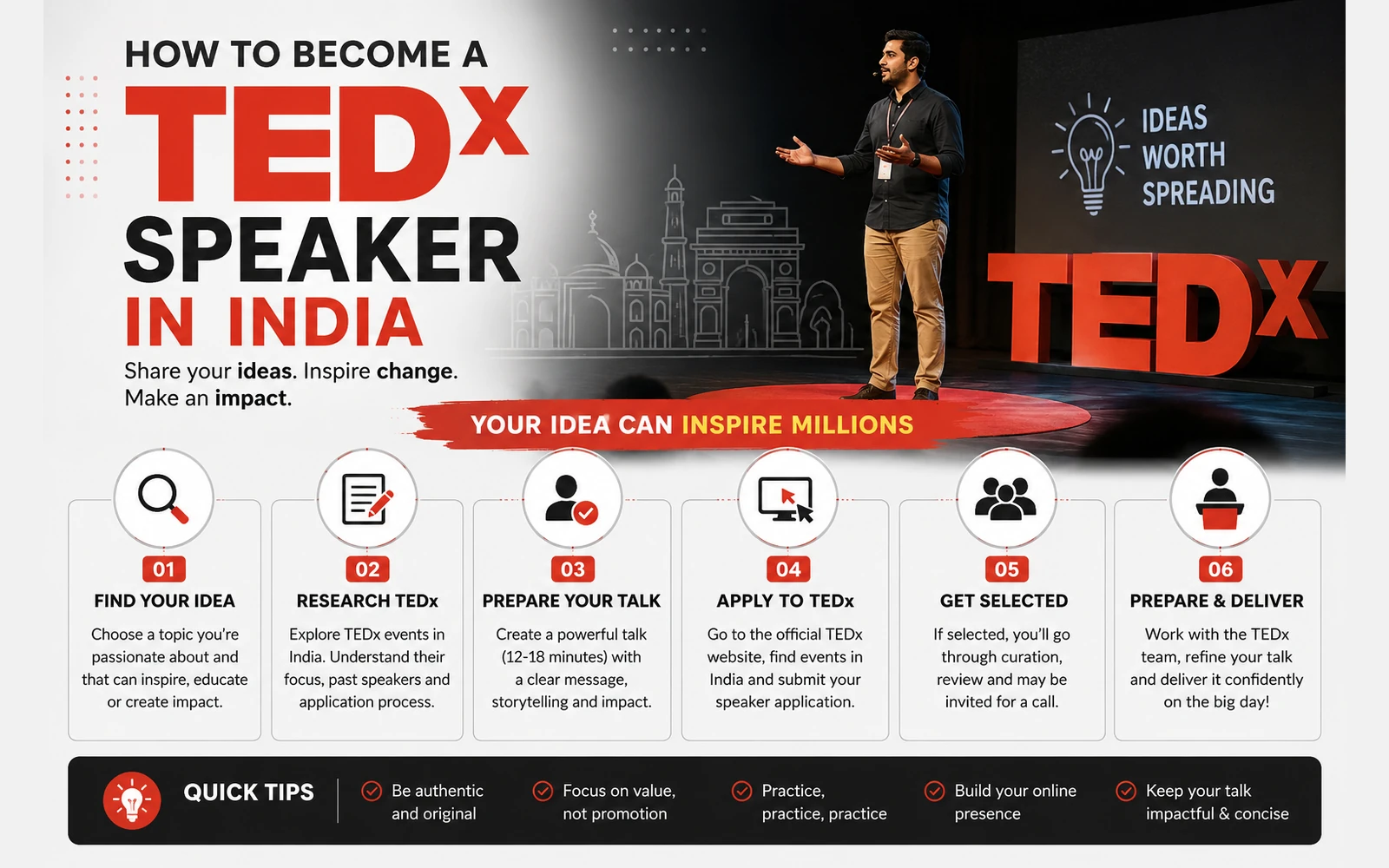
Search for how to become a TEDx speaker in India and you will find plenty of inspiration and very little instruction. Meanwhile, every month, hundreds of TEDx events across India quietly select speakers — many of whom are not celebrities, bestselling authors, or unicorn founders. They are professionals who understood how the selection process works and prepared for it deliberately.
This is the complete process: how TEDx events choose speakers in India, how to build an idea worth spreading, how to apply (and to whom), and what actually happens after you are selected.
How TEDx Speaker Selection Actually Works in India
TEDx events are independently organised under licence from TED. That single fact changes your entire strategy: you are not applying to “TED” — you are applying to individual organising teams in Jaipur, Pune, Indore, Gurugram, or one of the hundreds of college and city events licensed each year. Every team has its own theme, curation taste, and application route.
Most Indian TEDx events fill their speaker line-up three ways: direct invitations to people the curators already admire, nominations through networks, and open applications. Your job is to become findable for the first, referable for the second, and outstanding in the third.
Build the Idea Before You Build the Application
TEDx selects ideas, not resumes
The most common rejection reason is brutal: the applicant pitched their success story instead of an idea. “How I built my company” is a biography. “Why India’s small towns will out-innovate its metros — and what I learned building there” is an idea worth spreading. Curators ask one question: will the audience think differently after this talk?
The one-line test
Write your idea as a single sentence that contains a tension or reversal. If your sentence could be said by a thousand other people in your industry, sharpen it until it could only come from you. This same discipline powers strong founder personal branding — your talk and your positioning should reinforce each other.
Proof beats passion
Indian TEDx curators receive floods of motivational abstracts. What stands out is specificity: data from your work, a lived experiment, a failure with a lesson that generalises. Passion is assumed; evidence is rare.
The Application Process, Step by Step
Step 1: Shortlist the right events
Search for active TEDx events in your region and sector affinity. A first-time speaker has better odds at university and tier-2 city events than at flagship metro events. The red circle carries weight everywhere — the venue matters less than you think.
Step 2: Prepare your speaker one-pager
Curators decide in minutes. Give them: your idea in one line, why you (two or three lines of credibility), a 60–90 second video of you speaking naturally on the idea, and links to anything that proves you can hold a stage — a podcast, a panel, even a well-shot reel. If your name returns credible media coverage on Google, your odds improve sharply; this is where earned media quietly does its work.
Step 3: Apply and nominate in parallel
Submit open applications where available, but also work the nomination route: past speakers, organisers’ networks, and industry bodies connected to the event’s theme. A warm nomination with the same one-pager multiplies your chances.
Step 4: Expect a curation conversation
Shortlisted speakers typically face a call or audition where curators probe the idea’s originality and your delivery. They are not looking for polish — they are looking for clarity and coachability, because every TEDx talk goes through rehearsal cycles with the curation team.
After Selection: The Part Nobody Prepares You For
A TEDx talk is rewritten more than it is written. Expect four to eight weeks of drafts, rehearsals, and cuts — the eighteen-minute ceiling is enforced, and most strong talks land between eight and fourteen minutes. Memorise structure, not sentences. And plan the after-life of the talk before you step on stage: the video on YouTube, clipped for LinkedIn and Instagram, cited in your media kit, referenced in interviews. A TEDx talk that nobody amplifies is a missed asset — amplified well, it becomes a credibility engine that supports everything from press features to TV panel invitations.
Common Mistakes That Get Applications Rejected
Pitching a sales talk — any hint that your talk promotes your company is disqualifying under TEDx rules. Choosing a topic outside your lived authority. Submitting without any video evidence of speaking ability. Applying only to one flagship event and giving up. And underestimating timelines: strong applicants often engage with events three to six months before the event date, not three weeks.
Frequently Asked Questions
Do TEDx speakers get paid in India?
No. TEDx events do not pay speakers, and speakers cannot pay to be selected — both are against TED rules. The return is credibility, reach, and the long-term asset of a talk on the TEDx YouTube channel.
Can anyone apply for a TEDx talk?
Yes. TEDx events are independently curated, and most accept open applications or nominations. Selection depends on the strength and originality of your idea, evidence you can deliver it, and fit with the event’s theme.
How long does it take to become a TEDx speaker?
Typically three to six months from targeting events to standing on stage — including application, curation conversations, and mandatory rehearsal cycles. Speakers with an existing public footprint move faster because curators can verify them quickly.
About Trace Presence
Trace Presence is a PR and marketing agency built on one principle: coverage that is earned, never bought. We help founders and professionals craft their idea, build the credibility footprint curators look for, and position them for TEDx stages, media features, and speaking opportunities. See our services or start a conversation.